A love story
Two Cups of Cutting Chai

for Aanya
written by Kabir · since 14 February 2024
Scroll to open your book
Two Cups of Cutting Chai
The story of Aanya and Kabir, written for Aanya
Kabir & Aanya
This book is dedicated
For Gulab Jamun, who is soft inside and will never admit it. Every page of this book is yours.
Contents
- ·Before We Begin
- 1The Ordinary Day Before You
- 2The Last Copy
- 3Too Serious, Too Funny
- 4Maggi, Chai and a Small Umbrella
- 5Falling, Slowly and Then Quickly
- 6The Moment I Knew
- 7Our Moments, Part One
- 8Our Moments, Part Two
- 9Gulab Jamun and the Secret Words
- 10The Little Things You Do
- 11The Long Distance Months
- 12Ordinary Days, Extraordinary Us
- 13Ahead of Us, Together
- ·Our Firsts
- ·97 Reasons I Love You
- ·What I Promise You
- ·In My Own Words
- ·A Letter For You
The two of us
- Together since
- 14 February 2024
- Days of us
- 1,014 and counting
- What I call you
- Gulab Jamun
- Our song
- Tum Se Hi
- Our place
- The corner table in the library
- Chapters
- 13, and many more to come
Before we begin
I have started this book a dozen times, always with the same worry. Every sentence I write about you feels too small, as if I am trying to fit the ocean into a steel tumbler. So I have decided to stop trying to be perfect and simply tell you what happened, the way I remember it, with all the messy details that I know you will tease me about. You once said I remember the wrong things, that I will recall the exact colour of your kurta but forget to bring the umbrella. Maybe that is true. But I remember you, and I remember us, and that is the only thing I need to get right.
This book is also a small confession. Some of the best parts of my life happened so quietly that I almost missed them: a corner table near a window, a hoodie that became yours without anyone asking, a phone propped against a pillow while we both drifted off mid-sentence. I want you to have these moments in one place, in your hands, so you can read them slowly on a day when the world feels loud. Whenever you need proof that you are loved, I hope you will open these pages and find it waiting for you, just as you always found the nineteen notes and wondered about the other two.
— Kabir
Chapter One
1
The Ordinary Day Before You
Before you, every day had the same shape, and I did not mind.
Before I knew you, my days were built out of routine and deadlines. I woke up, I went to class, I sat in the library with a stack of notes that never seemed to get any shorter, and I told myself that this was what a serious second year looked like. I was the kind of person who believed that being busy was the same thing as being happy. I had friends who made me laugh, a bike that needed servicing, and a list of things I wanted to do someday that never quite turned into a plan.
The library was my second home in those months. It smelled of old paper, of the rain that clung to umbrellas at the door, and of the tired fluorescent light that made everyone look a little pale. I liked the quiet there. Nobody expected me to explain myself. I could sit with a highlighter and feel that I was moving forward, even if the pages in front of me barely changed. Looking back, I think I was waiting for something to interrupt the rhythm, even though I would never have admitted it to anyone.
My statistics book was the centre of my world that semester. It was heavy, with a cracked spine and a chapter on probability that made my head ache. I had been meaning to buy my own copy for weeks, but money was tight and I kept finding reasons to put it off. So I went to the library that afternoon expecting to borrow the one copy they had, the way I always did, and I felt a small, stupid hope that it would still be on the shelf.
I remember the light that day. It came through the tall window in a slanted gold patch that landed on the corner table, the one that would soon become ours. I remember the sound of a chair scraping, the hum of the photocopier down the hall, and the way my shoulders dropped when I saw the shelf. It was almost empty. Almost. There was one thin book left, and I was reaching for it when someone else reached for it too.
One thin book, one stubborn girl, and a day I almost missed.
I did not know then that this ordinary moment would become the first page of everything. I only knew I was annoyed, a little tired, and very hungry, and that the universe had chosen the exact wrong afternoon to make me wait. I had no idea that the person beside me, with headphones hanging around her neck and a serious expression that dared me to argue, would become the most important person in my life. I was simply trying to get the book I needed so I could go home and sleep.
Maybe that is why I think of that day as ordinary. Nothing about it was grand. There was no music swelling in the background, no dramatic sunset, no speech. There was just a shelf, a stubborn grip on a book, and a moment of hesitation that felt like nothing at all. Yet I have learned that the most important beginnings often arrive dressed as small inconveniences. If I had gone to the other library, or come an hour later, or decided the statistics could wait, I would still be the same person I was then, and I would be missing the best part of myself.
So this chapter is about the boy I was before you, the one who thought he had his life figured out. He was not unhappy. He was simply missing a laugh he had never heard, a voice he had never argued with, and a corner table where two people could spread out their notes and somehow end up talking about everything except the notes. He did not know that his whole life was about to be rearranged by one thin book and one stubborn girl.
I want you to know that I am grateful for that boy, even though he was a little dull and very certain of himself. He gave me the habit of showing up. He taught me to be patient when things felt slow. And he was waiting, without knowing it, for you to walk into that library and make him forget every plan he had ever written down. That is the truth of my before, and I would not change a single page of it, because every page led me to you.
When I think about that afternoon now, I feel a warm rush of something close to amusement. I can picture my own face, frowning at the shelf, trying to look casual and failing. I can picture your back, straight and determined, as you held on to that book the way you hold on to everything you think is yours. Neither of us was being charming. We were just two people with exams coming and nowhere else to be, and somehow that was enough for the story to begin.
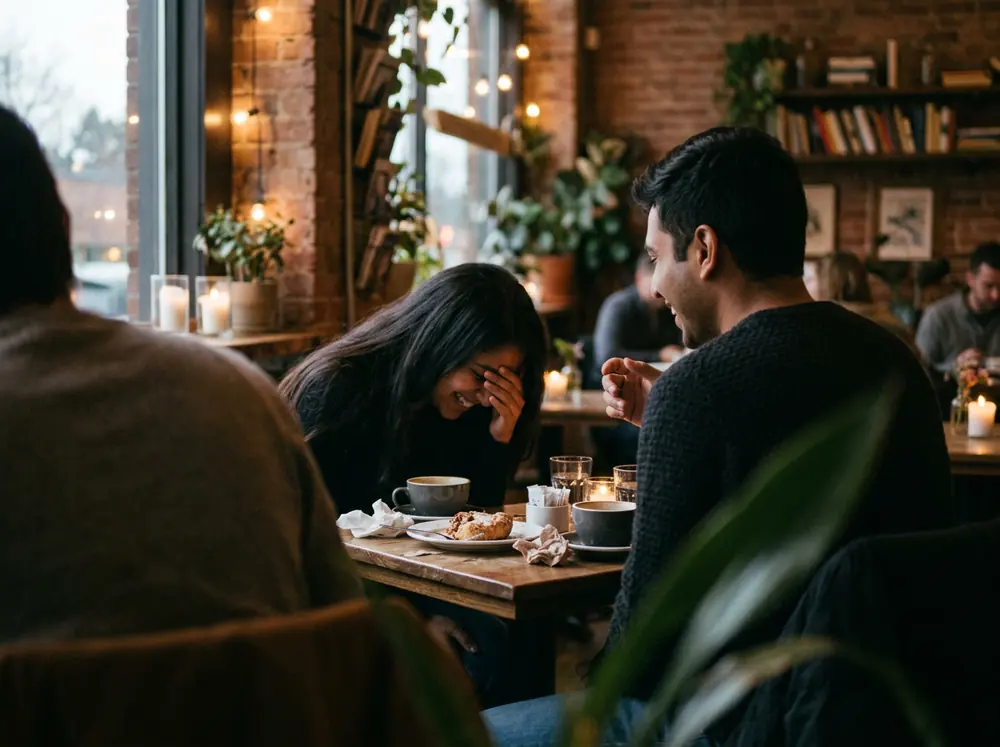
Chapter One
Chapter Two
2
The Last Copy
We both reached for the same book, and neither of us let go.
The moment itself was almost comic when I think about it now. I reached for the statistics book at the same time as a girl with a lot of hair pinned up in a hurry and a pair of headphones resting on her shoulders like they were part of her uniform. Our fingers touched on the spine. I pulled. She pulled back. For a second neither of us spoke, and the only sound was the faint, tinny music leaking from her headphones, something old and soft that I could not quite place.
You looked at me then, properly, for the first time. Your eyes were dark and suspicious, the way eyes look when someone has just tried to take the last thing you wanted. I remember thinking that you looked far too serious to be fighting over a textbook. I remember also thinking, with some surprise, that you were beautiful in a way that did not ask for attention. You were not trying to be seen. You were simply holding your ground, and that made you impossible to ignore.
I said something like, I think I was here first, which was not true at all. You raised one eyebrow and said that the shelf was not a queue, and that you had been looking for this book since morning. I tried to argue that I had been looking for it since morning too, and you told me, very calmly, that my face did not look like someone who had been looking for anything since morning. I laughed, which annoyed you more, and then you did something I still remember with a fondness that makes my chest tight.
You let go. Not all at once, and not gracefully, but you let go of the book and gave me a small, dramatic sigh. Then you said that since we both clearly needed it, we could fight for it like civilised people or we could share it like sensible ones. I was too surprised to answer properly. I only nodded, and you walked toward the corner table near the window, and without thinking I followed you, carrying nothing but my pride and a sudden, quiet curiosity about who you were.
You let go of the book, and somehow I started holding on to you.
The table was the one by the window, slightly wobbly on one side, with a folded piece of cardboard under one leg that someone had pushed there years ago. You sat down and placed the book between us as if it were a treaty. I sat across from you, pulled out my notebook, and tried to look like a person who had come to study. The light from the window fell across your hands, and I noticed you had a tiny chipped nail polish on one finger, a detail I would later tease you about for months.
What I did not know then was that this was the beginning of a routine. Every evening after that, we would find the corner table without discussing it. You would arrive first, usually with two pens and an apology for being late. I would arrive second, with a question I had already forgotten the answer to. We would share the book, pages turning back and forth between our hands, and sometimes we studied and sometimes we did not. The shared book became an excuse I did not need.
There is something about being forced to share that makes people honest. You could not hide behind your headphones forever, and I could not pretend to be more organised than I was. Over those first days, the rules we had quietly agreed on began to matter less than the small things we noticed about each other. You underlined everything in green. I underlined everything twice. You hummed when you were concentrating and stopped the moment you realised you were humming.
I think the first real thought I had about you came that week, on a quiet evening when the window had gone dark and the library lights buzzed above us. You had your chin on your palm and were staring at a graph, and I was pretending to read while watching you read. I remember feeling a strange lightness, as though someone had opened a window in a room I had not realised was stuffy. It was not romantic yet. It was simply the feeling of wanting to know more.
So this chapter belongs to the last copy of a statistics book, and to the way you let it go so easily once you had decided I was worth sharing with. Looking back, you gave me something much bigger than a textbook. You gave me a reason to walk toward a table I had walked past a hundred times, and a reason to look up when the door opened, just in case it was you.

Chapter Two
Chapter Three
3
Too Serious, Too Funny
First impressions are rarely right, but they are always honest about what we notice first.
If you asked me on that first week what I thought of you, I would have given you a very neat, slightly unfair answer. You were too serious. You had headphones on almost all the time, even when there was nothing playing, and I suspected you used them the way other people used closed doors. You did not smile at strangers. You did not waste words. When someone was talking too much, you looked at them with a steady, patient expression that made them feel slightly foolish, and I found that both intimidating and fascinating.
I also thought you were a little cold, which I now know was completely wrong. What I saw as coldness was really a kind of protectiveness. You were careful with your heart, and you did not hand out your laughter the way some people hand out visiting cards. I did not understand that yet. I only saw a girl who seemed to have built a wall and decided that the wall was the whole house. It made me curious in a way I did not expect, and it made me want to test the walls.
I made the mistake of trying to be funny too early. I was nervous, and nervous me reaches for the worst jokes in the world. I told you a joke about a statistician who could not commit to a sample size, and it was so bad that I could feel the silence stretch between us. I remember my ears going warm. I remember you blinking at me, slowly, as if you were deciding whether I was worth the effort of a reaction. Then you laughed.
It was not a polite laugh. It started small, a short breath through the nose, then a shoulder shake, and then something bright and surprised that made the people at the next table look up. You covered your mouth with your hand, as if you were embarrassed, and that made the laugh even louder. I was so startled that I forgot my next line. I just sat there, watching the most serious girl in the library completely lose control over a joke that was not even good.
You were too serious, and I was wrong about almost everything else.
That laugh is the thing I could not stop thinking about. For days afterward, I replayed it in my head during lectures, on the bus, in the shower, while buying tea from the stall near the gate. It was not just the sound. It was the way you seemed to let go of something when you laughed, as though for a moment the wall had a gap in it and I could see straight through to the soft, warm person behind it. I wanted to hear that laugh again, and I wanted to be the reason for it.
What I got wrong was thinking that seriousness meant being unreachable. You were not hard to reach. You were just careful about who you let close, and you had good reasons to be careful. I learned that later, slowly, in small pieces that you gave me without meaning to. A story about a cousin, a quiet comment about how you hated being the centre of attention, a look you gave me when someone was rude to a waiter. Each piece told me that your seriousness was really a kind of loyalty.
I also got wrong my first impression of your headphones. I thought they were a barrier, and sometimes they were, but I also noticed that you took them off whenever someone spoke to you directly. You never made people feel that they were interrupting you. It was your way of saying that you were ready to listen, once you had decided it was worth your attention. That is still one of the things I admire most about you, and I did not understand it at all in those first weeks.
What I saw in you, in the beginning, was a sort of steadiness. Even when you were irritated, your hands stayed still. Even when you were tired, you kept your notes neat. I was used to people who rushed through everything, including me, so your calm felt like a pool of cool water. I wanted to stand in it for a while and see how it felt. Turns out it feels like being understood without having to explain yourself, which is a rare thing to feel from someone you have known for only a week.
So if I am honest, my first impression of you was half wrong and half right. You were serious, and I was right to notice it. You were also funny, sharper than anyone I had met in months, and I was wrong to think the seriousness was the whole story. I am glad I was wrong. If I had only seen the wall, I would have walked away, and I would have missed the laugh that changed the way I heard my own name.
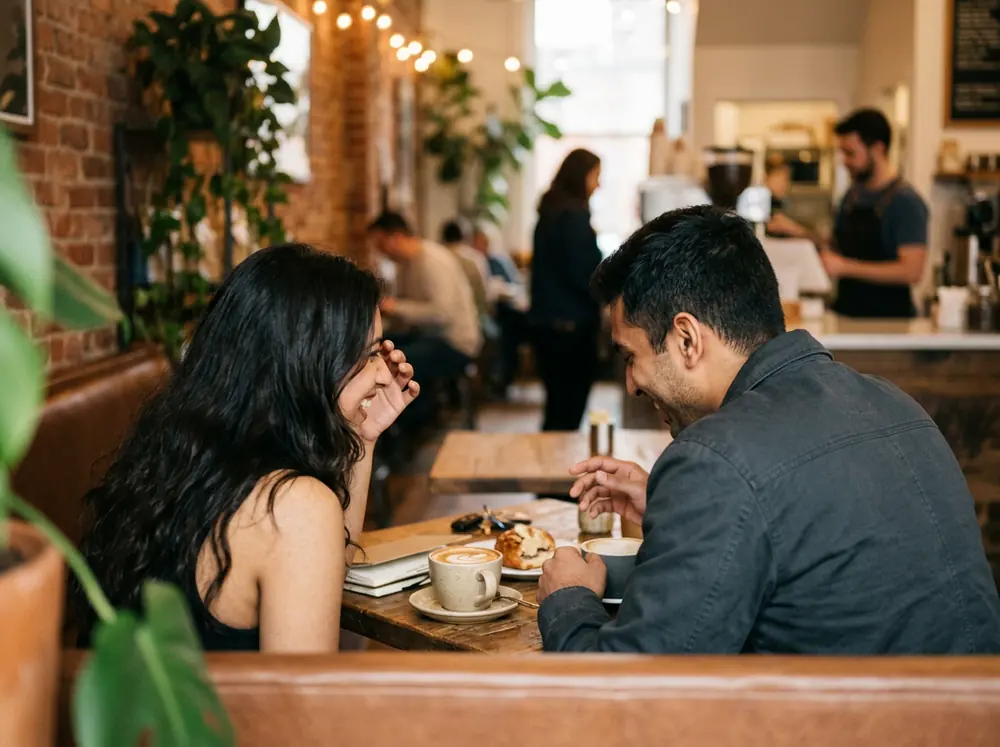
Chapter Three
Chapter Four
4
Maggi, Chai and a Small Umbrella
We talked until the rain decided to stay, and so did we.
The first real conversation happened outside the library, not inside it, which is a fact I think about often. Exams had just ended, and everyone was rushing out of the building with the relief that only comes after three hours of writing with a pen that keeps running dry. I was walking toward the gate when I saw you standing near the tapri, looking at the sky with a frown. Dark clouds had gathered over the college roofs, and the first fat drops were hitting the tin shed above the stall.
I did not plan to speak to you. I want to be clear about that, because later you accused me of planning everything, and I was not that clever. I walked over because the tapri was the only place to be, and because I could smell cutting chai, sharp and sweet, rising through the damp air. The man behind the counter was stirring a big steel pot with a long spoon, and the steam was curling around the Maggi packets hanging by the window. You looked at me and said, very drily, that it was about to rain. I said I had noticed.
We ordered Maggi and two cutting chais. I remember the small plastic plate, the way the noodles were a little too soft, and the chai that burned the roof of my mouth in the best way. You blew on yours and said that the first sip always tasted like a promise that you would be fine. I asked what the second sip tasted like. You said, very seriously, that by the second sip you had usually forgotten the promise. I laughed so loudly the stall owner looked over.
Then the rain came properly, the kind that turns the road into a river in a few minutes. We were both standing under the shelter, close to the edge, and you did not have an umbrella. I had a small one, almost useless for two people, folded in my bag. I took it out and opened it, and you looked at it with deep suspicion. You asked whether I expected both of us to fit under something that barely covered my head. I said that we could try, and you said that was the most unreasonable plan you had ever heard. You stepped under it anyway.
Three hours under one small umbrella, and I never once wanted to go home.
We stood there for almost three hours, though it felt like twenty minutes. The rain kept falling, the chai kept coming, and the conversation went everywhere. You told me about wanting to be an engineer before you realised numbers could be funny. I told you about my younger cousin who believed every lizard in our house was a spy. You told me that you hated the sound of crowded trains and loved the smell of wet earth. I told you that I was often the last to know when things were wrong with people I cared about, and you looked at me for a long moment before saying, quietly, that you had noticed.
I cannot remember every word, and I think that is the point. What I remember is the feeling of your shoulder against mine under the small umbrella, and the way I kept shifting the handle so the rain would not drip down your sleeve. You kept shifting it back. At some point we stopped talking about anything specific and simply talked, the way two people do when they have found a rhythm and do not want to break it. Time went strange. Every time I checked my watch, I was surprised by how little I minded being late.
When the rain finally eased, the road was still shining and the air smelled clean and cold. You said you should go, and I said I should go too, and neither of us moved. Then you asked if I wanted to walk to the bus stop, and I said yes so quickly that you laughed. That laugh again. It was starting to feel like the sound I would hear first in every good day. We walked slowly, shoes splashing in shallow puddles, and I did not want the road to end.
Later, when I tried to explain to my friends what had happened, I could only describe it as ordinary. Maggi, chai, rain, a small umbrella, an argument about who was holding it. None of that sounded like the start of anything. But I knew, even then, that I had talked to someone for three hours and felt more awake than I had felt in months. I knew that I wanted to talk to you again tomorrow, and the day after, and that the feeling was not going to fade with the rain.
I think sometimes about how close we came to missing it. If I had left the library a few minutes earlier, or taken a different gate, or decided that tea was a waste of money, the clouds would have opened over an empty pavement. Instead, I stood under a tin roof with you and a cup of chai that was too hot, and I listened to you tell me what you wanted from life. That is what I keep returning to. Not the rain, not the noodles, but the fact that you chose to stay under the umbrella when you could have walked away.

Chapter Four
Chapter Five
5
Falling, Slowly and Then Quickly
It did not happen all at once, it happened every evening at the same window.
After the rain, things changed in small ways that were easy to miss and impossible to forget. We began meeting at the corner table even on days when we had no exam to study for. You would send me a message in the afternoon with just a time and a place, no greeting, and I would reply with a single word and then spend the rest of the day smiling at my phone like a fool. I told myself it was just friendship. I told myself a lot of things that were not true.
Our first proper date was not planned as a date. We went back to the tapri because it felt like the right place to go, and the stall owner greeted us with a knowing grin, as though he had been waiting for us to return. We ordered two cutting chais and one plate of Maggi to share, and you pretended you did not want the last bite. I did not believe you. You took it anyway, very slowly, while I watched and tried to act unbothered.
Falling for you felt less like a fall and more like a series of small steps taken in the dark, each one landing on something solid. You remembered that I hated coriander and picked it out of my sandwiches without comment. I remembered that you liked your chai with extra sugar and no ginger, and I stopped asking the stall owner to change it every time. Those little acknowledgements built something between us, brick by brick, until one day I looked around and realised the house was already standing.
I remember a particular evening in late February, the kind of evening where the wind comes in from the south and smells faintly of rain that has not yet arrived. We were walking back from the library, and you were complaining about a professor who had marked your paper with a red pen so aggressive that it looked like a crime scene. I was laughing at your description, and you suddenly stopped and told me, half angrily, that I had a stupid laugh and that you liked it too much. I did not know what to say, so I said thank you, which made you groan.
It did not happen all at once, it happened one ordinary evening at a time.
That was the first time I thought, clearly and without any joke attached, that I wanted to be with you. Not just study with you or talk to you under an umbrella, but be yours in the way people talk about on quiet nights. The thought scared me a little, because I knew how easily things could go wrong. But it also felt like standing at the edge of a warm lake, with the sun on my face and the water inviting me in.
I did not say anything for a few days. You did not say anything either, but your hand brushed mine more often when we were walking, and you stopped taking your headphones off in the library unless I was talking. Those were your signals, I realised later, and they were as clear as any words. I started to plan little things, like keeping a spare pen for you, or remembering the exact page you were stuck on, and I felt a happiness so simple that it made me slightly giddy.
When I finally asked you to be my girlfriend, it was not dramatic. We were sitting at the corner table near the window, with the book between us and the lights of the parking lot glowing below. I had practised a speech in my head for three days, and when the moment came, I forgot all of it. I just said your name and asked if you would let me be the person you shared things with. You looked at me for a long time, then said, very softly, that you had been waiting for me to ask since the day I laughed at my own bad joke.
We made it official on a Valentine's week evening in February, which you pretended to hate. You said it was too obvious and too commercial, and then you spent twenty minutes choosing which chai to share at the tapri. I think that was the moment I understood how much you cared about the small rituals of love, even when you refused to call them romantic. You wanted to be loved in ordinary ways, in cups and shared spoons and walks home in the rain.
If I could go back to that evening and stand beside myself, I would tell him to enjoy every second, even the awkward ones. He would not understand how much would change. He would not know about the scooty ride to the sea or the nineteen birthday notes or the long calls from another city. He would only know the warmth of your hand, the taste of tea on his tongue, and the quiet certainty that something important had begun. He would be right.
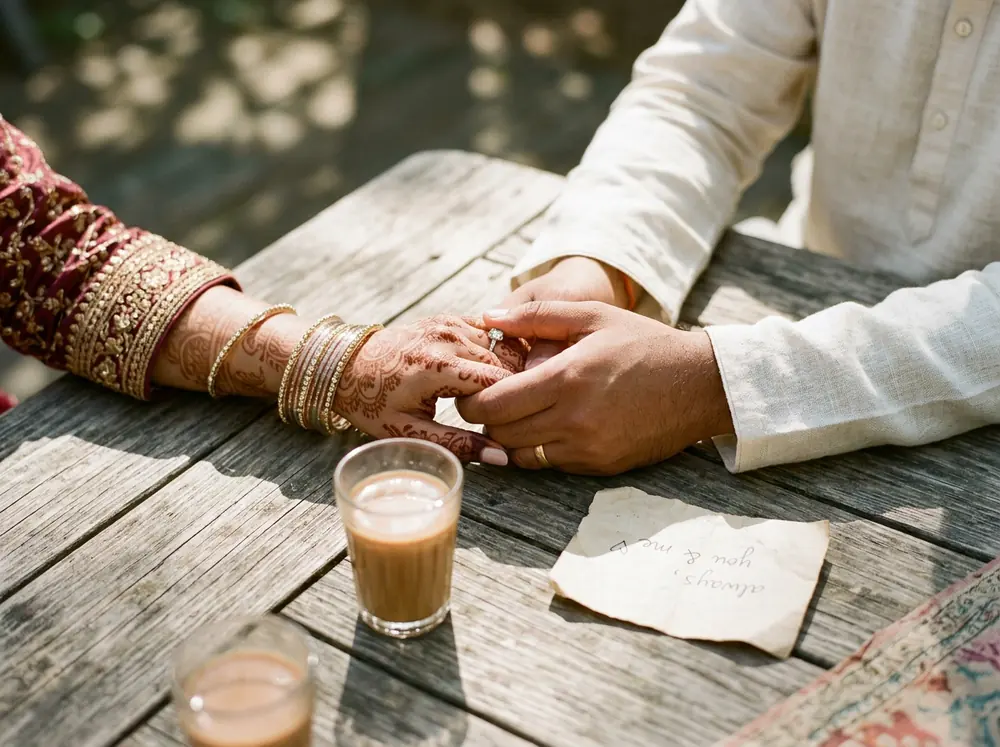
Chapter Five
Chapter Six
6
The Moment I Knew
Some certainties arrive without fanfare, wearing a borrowed hoodie.
People often ask how I knew, and I usually give a funny answer about your terrible taste in music. The truth is harder to explain. I knew in pieces, over many weeks, until one evening the pieces clicked together and I could no longer pretend that I was simply enjoying your company. The moment that finally made it clear happened on an ordinary Tuesday, in the middle of a conversation about nothing important. You were telling me about your mother's cooking, and your face went soft in a way I had not seen before.
It was not your beauty that undid me, though I will admit it helped. It was the way you talked about the people you loved. You spoke about your family with a kind of protective tenderness, as if you were holding them in both hands. When you talked about your friends, you remembered the tiny details: which one was afraid of thunder, which one hated sweet things, which one had the worst handwriting in the world. I realised that I wanted to be someone whose details you would remember with that same care.
Another piece came during a long wait at the bus stop after a late lecture. It was cold, and you were wearing a hoodie that was far too big for you. You pulled the sleeves over your hands and said, almost to yourself, that you had nothing warm enough for January. I took off my jacket and put it over your shoulders without thinking. You did not argue. You just tucked your chin into the collar and said that this was not fair because my jacket smelled like your favourite shampoo. I laughed, but inside I was not laughing at all. I was simply glad.
Then there was the night you called me, very late, after a long argument with a friend. You did not want to talk about it. You just wanted to hear my voice while you walked home, so I stayed on the phone and told you about the stupidest thing I could remember, a story about a broken scooter and a goat that refused to move. You laughed until you were out of breath, and then you were quiet for a while. I could hear your footsteps, the traffic, the faint hum of your keys. When you finally said goodnight, I sat in the dark for a long time, smiling at nothing.
I knew it in pieces, and then all at once, under a borrowed jacket.
That was the moment I knew I did not want anyone else to be the person you called after a bad day. I wanted that to be me, always, without having to be asked. It was a simple wish, but it felt enormous, and it felt true. I do not think love always announces itself with music. Sometimes it sits quietly next to you on a bus stop bench and asks nothing except that you stay close.
I want to be honest about the fear that came with that realisation. I had never been so sure about anything, and that sureness felt like standing on a ledge. What if I was wrong about what you felt? What if I was too much, too quick, too eager to make you mine? I did not voice any of it. Instead, I tried to be steady, the way you had been steady for me, and I waited for the ground to hold. It did. Every day you gave me another small reason to believe that you were walking toward me too.
I remember telling my closest friend that I thought I might be in love, and he looked at me with a grin that said he had known for months. He asked what I was going to do about it. I said I was going to keep showing up at the corner table, keep sharing the same book, and keep trying to make you laugh until your hand covered your mouth. He said that sounded very dangerous and very romantic, and I told him that was exactly the point.
So the moment I knew was not one moment. It was a collection of ordinary kindnesses, a borrowed jacket, a late phone call, a hoodie that smelled of you, and the way your voice changed when you talked about the people you loved. Each one was small. Together they formed a certainty so warm and so solid that I stopped questioning it. I knew I wanted to spend my evenings with you, my mornings with you, and every version of the future that had you in it. I still feel that certainty when you walk into a room, slightly out of breath, saying you are only five minutes late.

Chapter Six
Chapter Seven
7
Our Moments, Part One
Some days ask to be written down, so that they never stop being true.
This chapter is about the first half of the memories that feel most like us, and I want to start with the trip to Goa in December 2024. It was our first trip together, and it still lives in my head as a string of golden light. We rode a scooty along the coastal road, you in front with your hands on the handlebars and your hair whipping across my face, me behind you holding on a little too tightly. You shouted over the wind that I was squeezing you like a bag of potatoes, and I shouted back that you had said the same thing three times already.
We went to the lighthouse on the afternoon of our second day. The sky was pale and bright, and the sea below was a shade of blue I had never seen in a photograph. You made me stop the scooty at every viewpoint, because every sunset looked like the one you would regret missing. You took photographs of the rocks, the waves, the fishing boats with their painted hulls, and then you turned the camera around and took photographs of me pretending to be annoyed. You said that forty photos were the only fair way to choose one. I think I was secretly thrilled.
The sunset that evening was the one you cared about most. We sat on a low wall near the lighthouse, our shoulders touching, and watched the sun slide into the sea as if it had somewhere better to be. You did not say anything for a long time, which was rare for you. Then you said that you liked the way the light made everyone look kinder. I looked at you, the orange glow on your cheek, and thought that the light was not making you kinder, it was just showing me what I already knew.
We missed the last ferry that night. I do not remember whose idea it was to walk along the beach instead of rushing back, but I remember the sound of the waves, cold water around our ankles, and your laughter ringing out over the sand. We were soaked, sandy and late, and we could not stop laughing about it. You said that this was the most typical thing that could happen to us, and that you would never let me plan a trip again. I said you had planned everything, which only made you laugh harder.
Forty photos to choose one, and I still think you chose the best one of us.
Then there is the birthday in June 2024, which I think of as the day I learned how much you hate being surprised and how much you secretly love it. I had spent weeks planning. I hid twenty-one small notes around your room while you were at college, tucked inside books, under the pillow, behind the photo frame of your grandmother, inside the pocket of your favourite hoodie. Each note had a single line, something small and specific, meant to make you smile when you found it.
You found nineteen. I know this because you came to find me the next morning with a pile of papers in your hands and an expression of fierce triumph. You read the notes aloud, one by one, pretending to be a judge at a competition. You laughed at the silly ones and went quiet at the sincere ones. Then you looked at me and said there were two still missing, and that you were going to find them, and that I should be very afraid. Two are still missing. I have never told you where they are, and I am not going to tell you now.
I want to be clear that this chapter is not only about the big moments. It is also about the small, bright memories that still make me grin. Like the time you made me hold your bag while you tried on five kurtas at a shop in the market, shouting out your opinions from behind the curtain. Or the afternoon when we sat on the library steps and you read my notes aloud in a voice that made my handwriting sound like poetry. These are the moments that filled the spaces between the big days, and they matter just as much.
When I look back at the first half of our story, I see a pattern of small adventures that became something larger. A borrowed book became a shared routine. A rainy tapri became a habit. A scooty ride to the sea became a memory we return to every time we want to feel young and reckless again. Each moment was a thread, and somehow those threads kept winding around us until they formed a rope strong enough to hold us through the harder days still to come.
So I hope you will read this part of the book slowly, with your headphones on or off, depending on your mood. Hum one of your old Kishore songs while you turn the pages. Remember the taste of salt in the air, the sound of your laugh on the beach, and the feeling of nineteen notes in your hands. Those were some of our best days, and I want you to know that I remember every single one of them, even the ones you insist I have got wrong.
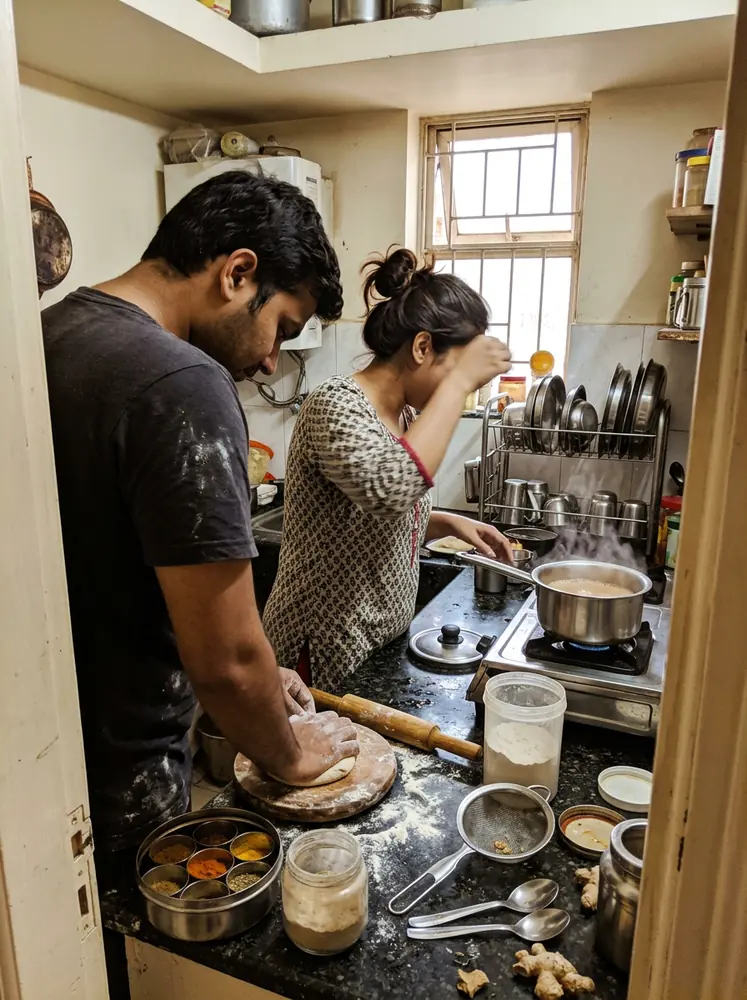
Chapter Seven
Chapter Eight
8
Our Moments, Part Two
Love is found in the rooms we share and the houses we are welcomed into.
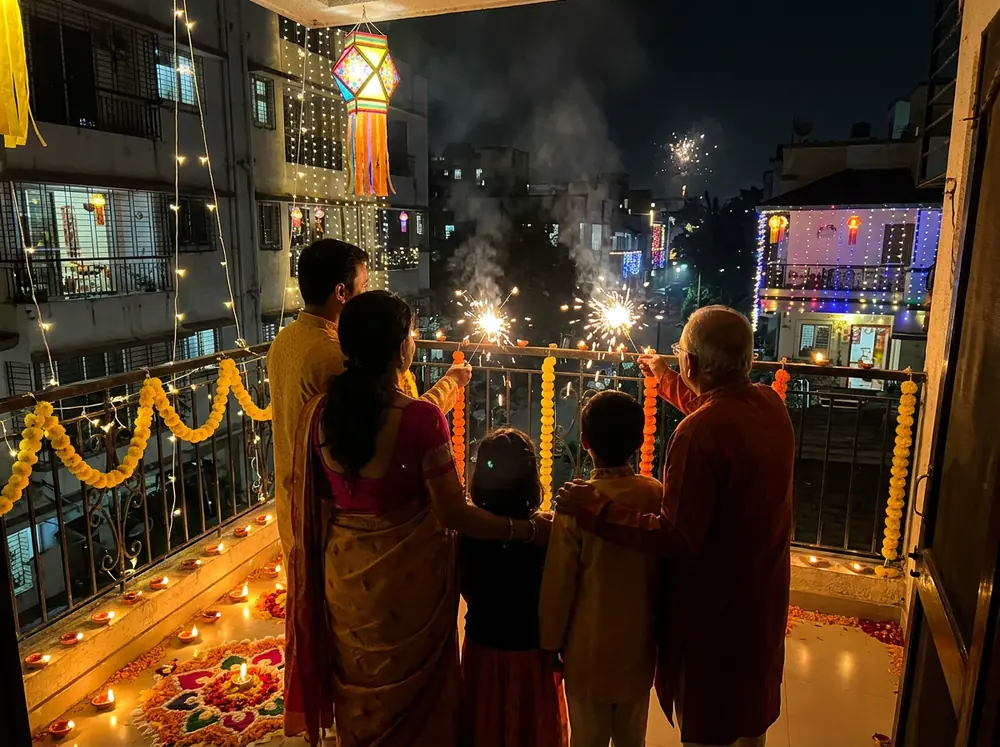
The second half of our memories begins with a day in November 2024, when I walked into your home for Diwali and met your parents for the first time. I was nervous in a way that made my hands feel too big for my pockets. I had brought sweets, which you told me later was the correct decision, and I had practised a few polite sentences in my head on the drive over. None of them survived the first minute, because your mother took one look at me and immediately began feeding me.
Your mother fed me five laddoos that evening. I know the number because you counted them out loud from the kitchen doorway, with a mixture of amusement and pity. Each one was soft and sweet, and I tried to say no after the second, and she simply pressed another into my palm and told me I was too thin. You rolled your eyes at me, but I could see that you were pleased. Diwali lamps lined the windowsill, their small flames trembling every time someone walked past, and the whole house smelled of ghee and sparklers and warm cardamom.
Your father asked me about my salary. There is no gentler way to tell it. He sat across from me on the sofa with a cup of tea, looked at me very seriously, and asked what I was doing with my life and what my plans were after college. I answered as honestly as I could, my voice steady only because I was so determined not to embarrass myself. You were in the kitchen, pretending not to listen, but I saw you peek through the doorway once with an expression that was half horror and half pride.
Under the dining table, while the family talked about cousins and festival plans, you took my hand. I did not expect it. Your fingers slipped into mine quietly, almost shyly, and held on through the rest of dinner. Nobody saw. Or at least nobody said anything. I remember staring at the tablecloth, my heart going very fast, while your thumb moved in small circles against my knuckles. It was the first time I felt that I belonged somewhere outside my own life, and it felt like being handed something fragile and precious.
You held my hand under the table, and that was the first time I felt at home with your family.
Later that night, after everyone had gone to bed and the house had gone quiet, you walked me to the gate. The street was lined with little clay lamps, and somewhere a firecracker popped and fizzed. You told me that my nervousness was adorable and that your father liked me more than he admitted. I said I did not believe you. You said that a man who asks about salary is a man who is already imagining a future with you, and then you blushed so fiercely that I forgot to be embarrassed myself.
Then there was the long distance season of 2025, which I will describe more fully in a later chapter. But it is part of this memory too, because it began with you moving to Pune for your new job. We said goodbye at the station on a grey morning, and I remember how light your bag felt in my hands when I helped you lift it onto the train. You promised to call every night, and you did. Those calls became a thread that connected my bedroom to your small room in a city I had only visited once.
Every night we talked for hours. Sometimes we talked about our days, and sometimes we just sat on the video call with our faces illuminated by our phone screens, not saying much at all. I would describe my day while you were making dinner. You would show me the view from your window, the streetlights and the distant buildings. Eventually we would both fall asleep on the call, our phones propped against pillows, your breathing soft and steady on the other end. I woke up more than once to the sound of you murmuring in your sleep.
I think about those nights often, because they taught me something about closeness. Distance is not only about the number of kilometres between two people. It is about the small rituals you keep alive even when your schedules are tangled. Mine was waking up early enough to say good morning before your first meeting. Yours was sending me a photo of a street vendor's cart with a note that said it looked like my kind of place. We built a life out of tiny gestures, and that life felt more real than many of the grander plans we had made together.
So this second part of our memories is really a collection of homes. Your family's home, with its lamps and laddoos and quiet hand under the table. The corner table, which felt like home in its own way. And the strange, glowing home we made on video calls, where two people fell asleep together across a hundred kilometres. I am grateful for each of these places, and for the people who taught me that love can be built anywhere, as long as both people keep showing up.

Chapter Eight
Chapter Nine
9
Gulab Jamun and the Secret Words
A name given in fun can become the warmest word in the house.
Every couple builds a small country of their own, with its own language, its own jokes and its own rules that nobody else quite understands. Ours began with a name. I call you Gulab Jamun, and I have called you that for so long that I sometimes forget it was not the first thing that came to mind. The reason is simple, and you will hate that I am about to explain it. You are soft inside, sweet and tender, and you pretend to be tough so nobody notices how much you feel. Gulab Jamun was the only name that fit that secret.
You pretend to hate it, of course. You say that it sounds like a dessert I have ordered from a menu, and that people will think you are sticky. Then you make me say it in front of your friends, and you blush a little, and you pretend you are annoyed that I have embarrassed you. I think you secretly like it more than any other name in the world. I know I do. When I say it quietly across a room, you look up with a small smile that you cannot hide, and in that moment the room becomes ours.
Then there are the nineteen notes and the two missing ones. Those two have become our most treasured inside joke. Whenever we are sitting in your room, I catch you glancing at the bookshelf, at the photo frame, at the pocket of your favourite hoodie, and I know you are thinking about them. You say that when you find the last two, you will have proof that I am a sneaky romantic who cannot be trusted with a secret. I say that the search is the best part, and that I will hide more notes someday, just to keep you busy.
Our song is Tum Se Hi, and it has a place in our history that is almost impossible to separate from our everyday life. You hum old Kishore songs while you cook, and this one comes back more often than any other. You start softly, usually when you are stirring something on the stove and do not realise you are doing it. I hear the first line from the kitchen, and I come to lean against the doorway and pretend I am not listening. You always catch me, and you always keep humming.
You are soft inside, and I will keep calling you Gulab Jamun until you admit it.
I think the song feels like us because it does not try too hard. It is gentle, a little wistful, and it has the sound of someone who has finally stopped searching. When you sing it badly, which you do with great confidence, I laugh so hard that you threaten to throw the spatula at me. I once told you that your voice sounds like a warm radio left on in the next room, and you said that was the most romantic thing a person had ever said to you while insulting your singing. We still argue about who sings the high part.
Our place is the corner table in the library, near the window, slightly wobbly, with the cardboard under one leg that neither of us has ever dared to remove. It is where we first shared a book, where you let go of the statistics text, and where I first saw you laugh so loudly that the room turned to look. We still go back there sometimes, even though the library has changed and the exam season is a distant memory. We sit at the table and place a single notebook between us, and somehow we always end up talking more than we write.
We have our own words for ordinary things too. Bas five minute, which you say before every outing, and which means that you will take at least thirty minutes and forty photographs. I say that I am a patient man, and you say that patience is a very kind word for stubbornness. We have a secret handshake that involves a complicated wiggle of fingers and a silly sound, and we only use it when we are alone or when someone is being overly serious. We call a bad mood a grey cloud, and a good mood a chai morning.
What I love about these words is that they do not mean much to anyone else, which is exactly why they matter. They are small signs that we see each other clearly, that we have been paying attention to each other's quirks and stories and silly habits. When I say Gulab Jamun in a crowded place, you know I am telling you that you are mine and that I am proud of the softness you hide. When you hum Tum Se Hi, I know you are telling me that you are happy.
So this chapter is a small dictionary of our private world, written for you and for nobody else. Our song, our table, our notes, our names, our little rituals. They are easy to overlook from the outside, but to us they are a language of trust. I hope we keep inventing new words for many years, because every new word means that we are still curious about each other, and still choosing to share the same book.
Chapter Nine
Chapter Ten
10
The Little Things You Do
Love often hides in the habits we stop noticing until they are gone.
There is a long list of things I love about you, and I could write them down on every page of this book and still not finish. But the little things are the ones that keep me awake at night with a warm feeling in my chest, so this chapter is for them. I want to begin with the way you listen. You listen with your whole body, leaning forward slightly, eyes steady, so completely present that people forget they are talking to someone with a busy mind. When I tell you something hard, you never rush to fix it. You just let it land, and then you ask the one question that makes me feel understood.
You also remember everyone's birthday. I do not mean you remember a few important ones. I mean you remember the birthday of your friend's cousin, the teacher from a school you left years ago, the neighbour's dog. You keep a little list in your phone, and every year you send messages at exactly the right time, usually with a small joke that makes people feel seen. I used to think it was a lot of effort. Now I think it is the most generous thing about you, the quiet proof that nobody is too small to be remembered.
Then there is your laugh, which I have mentioned before but which deserves its own paragraph. It starts small, a breath through the nose, the faint shake of your shoulders. Then it grows, bigger and brighter, until you are bent over and wiping your eyes and telling me to stop. I have heard that laugh in a library, on a beach, on a train platform, in the kitchen, and on a video call that froze halfway through. It is the sound I listen for when I want to know the day is going well.
You also have the gift of making everything feel easy. I am not an easy person. I overthink, I get anxious about small things, I forget to reply to messages until the next day. You take all of that and somehow make it lighter. When we plan something, you say, let's just see what happens, and then you make sure it happens beautifully. When I am stuck on a problem, you give me a cup of chai and a silly story, and the problem looks smaller. You make the world feel less heavy simply by being in it.
You remember everyone's birthday, and somehow you made me feel like I was remembered too.
Now for the habits, which are the things that make you so gloriously you. You hum old Kishore songs while you cook, always slightly off-key, always with total confidence. You steal my hoodies, and you have stolen so many that I have stopped buying new ones. I find them in your room, on your chair, wrapped around your shoulders at breakfast. You say they are yours now, and I say you are welcome to them, as long as you keep the one with the frayed cuff that I wear when I miss you.
You take forty photos to choose one. I used to think this was a waste of time, until I looked at the photos you chose and realised how carefully you look for light, for expression, for the small moment when someone forgets to pose. You also say bas five minute, and then you take thirty, and I have learned to bring a book whenever we go out. I have never once been truly angry about it. It is just part of how you love the world, by refusing to let a single good moment pass without trying to hold on to it.
There is also the way you fold your chai biscuit before you dunk it, pressing the edges together like you are closing a letter. You do not like crowded lifts, and you always take the stairs even when your legs are tired. You sleep with one hand under your cheek, and you wake up grumpy until you have had your first sip of tea. You cannot resist a stray kitten, even when you claim you are allergic to dust. These habits are small, but they are the map of you, and I have spent a lot of time learning every road.
What I love most, though, is the way you turn ordinary life into something soft and warm. You make the flat feel like a place to come home to, even when it is messy and full of half-read books. You notice when I have not eaten and leave food on the table with a note that says eat, or else. You notice when I am quiet and sit beside me without asking. You make me feel like the best version of myself is not something I have to earn, only something I am allowed to show.
So this is my honest list of little things, and I could keep adding to it forever. Your listening, your birthday memory, your laugh that grows, your easy warmth, your humming, your stolen hoodies, your forty photos and five minutes, your folded biscuits and stubborn stairs. None of these are dramatic. All of them are you, and I would recognise them anywhere, even in the dark, even if I had only heard your footsteps down a long corridor.
Chapter Eleven
11
The Long Distance Months
We were far apart for a while, and we chose each other again every single night.
I have been circling this chapter for a long time, because it is the one I most want to get right. The months of long distance in 2025 were the hardest we have had, and they were hard in a quiet, grinding way that did not look dramatic from the outside. You moved to Pune for your new job, and I had started my own job too, and suddenly our days had different shapes and different deadlines. We were both tired, both excited about our careers, and both lonelier than we wanted to admit.
The first few weeks were full of promises. We said we would call every night, and we did. But there were nights when my meeting ran late, or your project was due, or one of us simply had nothing left to say. I remember one evening when I was so exhausted that I fell asleep halfway through a sentence, and I woke to find your face still glowing on my phone screen, your eyes half closed, your voice whispering my name very softly. Neither of us said anything about it. We just kept the call going until morning, pretending it was the most normal thing in the world.
There were also misunderstandings, the kind that happen when people are stretched too thin. A message sent at the wrong time, a joke that landed badly, a silence that stretched too long on a call. Sometimes I felt like I was reaching across a wide river and our fingertips kept almost touching. I did not always say the right thing. Neither did you. We both had days when we felt small and unseen, and those days made us snap at each other in ways we later regretted.
I want to be honest about how hard it was to keep missing each other. Missing someone is a strange kind of ache, because it is both a sign of love and a source of pain. I missed the sound of your keys at the door, the weight of your head on my shoulder in the library, the way you stole my hoodie and then pretended it was always yours. Every time I saw a train station on a news clip, my chest went tight. Every time you sent a photo of a street I had never walked, I wished I could walk it with you.
We were far apart for months, and we chose each other every single night.
But we kept finding each other, and I think that is the real story of those months. We started to make small rituals that belonged only to the distance. I would send you a photo of my chai every morning, even if it was lukewarm and terrible. You would send me the view from your office window at lunch. We played a silly game where we each had to name one good thing that happened that day, even on the worst days, and some of our best laughs came from the most ridiculous answers.
We also learned to talk about the hard things instead of hiding them. There was a night when you told me that you felt guilty for being excited about your new job while I was struggling with mine. I told you that I was not struggling, I was just tired, and that I was proud of you for chasing something you loved. We sat with that honesty for a long time, and by the end of the call we were both crying a little and laughing at ourselves for being so dramatic. It was the first time I realised that talking through a bad feeling can be a kind of love.
Eventually the distance started to feel less like a wall and more like a road we were walking together, even if we were walking in different cities. We began to plan visits, to count days on a calendar, to imagine the moment when we would finally be in the same room again. Those plans gave us something to hold on to. Every time we reached a small goal, we celebrated with a video call and a silly toast with our respective cups of tea.
Looking back, I am proud of us, not because we were perfect, but because we chose each other on the days when it would have been easier to drift. We fell asleep on calls, we woke up to good morning messages, we fought, we made up, we learned that a bad week does not cancel a good life. That is what I want you to remember from this chapter. Distance tested us, and we did not break. We bent, we adjusted, and we came out the other side knowing that we are strong enough to carry each other across a long road.
If I could tell the earlier version of me something about those months, I would say that the ache is temporary, but the choosing is forever. Every night you picked up the phone, every morning I sent the photo of my chai, every time we said we were sorry, we were choosing the same thing. We were choosing us. And I am still choosing you, now that we are close enough to hear each other breathe, in the quiet of a shared room.
Chapter Twelve
12
Ordinary Days, Extraordinary Us
Some of the best love stories are made of nothing more than a normal Tuesday.
Since the hard months are behind us, I want to write about the days that make up most of our life. Not the trips, not the anniversaries, not the difficult seasons, but the regular, almost forgettable days when nothing special happens and everything feels right. These are the days I value most, because they are the proof that we have built something that does not need a reason to be beautiful. We wake up, we make tea, we argue about whose turn it is to wash the cups, and we go about our lives with a quiet sense of being home.
Our mornings usually begin with you humming. It might be a Kishore song, or the start of Tum Se Hi, or some half-remembered tune from a film neither of us has seen. You sing while you move around the kitchen, opening the cupboard, searching for the right spice jar, checking the milk. I lie in bed for a few extra minutes just to listen, and I think about how lucky I am to be woken by a sound that makes the whole room feel warmer. Then I get up, and you hand me a cup of chai without a word, and that is how the day starts.
Afternoons are quieter. You often work from the balcony, or at the small table by the window, surrounded by notebooks and a half-eaten packet of biscuits. I am usually in the other room, typing or reading, and every hour or so I hear your chair scrape back and your footsteps come closer. You bring me a question, or a funny message from a friend, or simply a hug from behind while I am sitting at the desk. These small interruptions are the best part of my day, even when I pretend they are distracting.
Evenings are for cooking, for talking, for little arguments about nothing. You cook with confidence and no recipe, and I chop vegetables badly while you tell me that I am doing it wrong. We eat at the table, and you steal the last piece of something I was saving. I steal your hoodie, the one you forgot on the chair, and you pretend to be angry until you see me wearing it, and then you laugh so hard that you have to sit down. These are not the moments people write about in films, but they are the moments that make a life.
The ordinary days with you are the ones I would choose again and again.
I think about how different this is from the person I was before you. He would have filled his evenings with studying or scrolling or waiting for something bigger to happen. He did not know that a quiet evening could feel like a celebration. You taught me that the regular days are the real treasure, and that love is mostly the careful attention we pay to the small, ordinary details. You remember how I like my tea. I remember the exact way you tie your hair when you are thinking hard. We have turned our routines into a kind of poetry.
Sometimes people ask me what it is like to live with someone you love, and I struggle to explain it. It is not always easy. We have different habits, different moods, different ways of handling stress. You like things neat, and I like them slightly chaotic. You plan everything, and I forget half the plans. But the difference is never a source of resentment. It is a source of curiosity, because every time we disagree I learn something new about how you see the world, and you learn something about how I see it too.
I also love the quiet ways you take care of me. You remember when I have an important meeting and send a message in the morning that just says go get them, with a tiny heart. You make sure I eat when I forget. You sit beside me when I am tired and put your head on my shoulder without asking me to say anything. You do not need a reason to be kind, and that is one of the many reasons I feel safe with you. I never have to earn your warmth. It is just there, like sunlight through a window.
When I try to explain why ordinary days with you are my favourite, I end up describing small pictures. The sound of rain on the balcony while we share a blanket. The smell of onions and garlic from the kitchen. Your laugh at a silly video on your phone. A quiet walk after dinner when the streetlights make everything look a little golden. None of these pictures would mean much on their own, but together they make a collection that I would never trade for any grand adventure.
So this chapter is my love letter to the ordinary, and to you, in the middle of it. The mornings with humming, the afternoons with interruptions, the evenings with stolen hoodies and disputed recipes. I hope that when you read this, you will recognise yourself in these pages, and feel how much I see you in the simple, unremarkable moments. Those moments are where we live, and I am grateful, every single day, that I get to live them with you.
Chapter Thirteen
13
Ahead of Us, Together
Our future is a small flat, a green balcony, and a dog named Biscuit waiting by the door.
I have been looking forward to writing this chapter, because it is the one where I get to imagine our future out loud. We have talked about it many times, usually late at night, when the day is finished and the ideas feel safer in the dark. You have a clear picture of what you want. I have a more scattered one, full of details I keep adding and changing. Put together, they make a home that feels exactly right, and I want to write it down so we can see it clearly whenever we need a reminder of where we are heading.
The first picture is a small flat. Not a grand place, just enough room for two people who like to spread their books across the table and argue about the thermostat. You want a kitchen with a window that gets morning light, because you say the best chai should be made in sunshine. I want a bookshelf that does not collapse under the weight of statistics textbooks and novels you keep promising to finish. We have not found the flat yet, but I can already picture the door, the hooks by the entrance where your hoodies will hang, and the small step where I will leave my shoes.
Next is the balcony, full of plants. You have a long list of plants you want to grow, some of them with names I cannot pronounce, and I have promised to keep them alive even though I have a terrible track record with anything green. We will have pots of mint for chai, a row of marigolds because you love their bright colour, and something climbing up the railing that will need constant attention. I imagine us sitting out there in the evenings with cups of tea, watching the city lights come on, pretending we are in a much bigger place than we are.
Then there is Biscuit, the dog who does not exist yet but already has a full personality in our conversations. You say Biscuit will be lazy and greedy and loyal, and will sleep in the exact spot where the sun falls in the afternoon. I say Biscuit will steal socks, and you say that is exactly the kind of thing a dog should do. We have argued about whether Biscuit should sleep on the bed, and we have agreed that the answer is no, unless it is very cold, or unless one of us is sad, in which case the rules can be bent.
Our future is built from small promises, a balcony of plants, and a dog named Biscuit.
The third promise, if I can call it that, is the trip to the mountains every year. We have not decided which mountains yet. You want somewhere with cold mornings and wooden cabins and a view that makes you forget your phone. I want somewhere with long walks and simple food and a small bonfire at night. We will probably argue about it for weeks, and we will probably take forty photographs of whatever view we finally choose, because you will insist that every good view deserves its own collection.
I also imagine the quieter future, the one that does not show up in lists. I picture us growing older together, still sharing a corner table somewhere, still humming songs that we half remember. I picture you still making me laugh until your hand covers your mouth. I picture us still counting down with five minute promises that stretch into thirty, still hiding small notes in each other's pockets, still searching for the last two missing ones that neither of us has ever found. The future feels full of those tiny rituals, and I want all of them.
I am aware that the future is uncertain. Jobs change, cities change, people change, and some days will be harder than we expect. But I have learned from our past that we can carry each other through difficult seasons, and that the best plans are the ones we can adjust together. So my dream is not a perfect life. It is a shared life, with room for mistakes, arguments, and long laughing evenings, where we keep choosing each other and keep building the small home we have been describing for so long.
This chapter ends with a promise that I hope will be easy to keep. I will keep making chai on Sundays, even when we are tired, even when the milk boils over and the sugar is wrong. I will never let a fight go to sleep with us, even if the sleep is a short one and the apology is clumsy. These promises are small, but they are the foundation of the future I see for us. Everything else, the flat, the balcony, Biscuit, the mountains, is built on the simple decision to keep showing up for each other.
A little timeline
Our Firsts
First hello
The first hello happened over a shelf with only one book left, when neither of us wanted to let go first. It was a tiny clash that turned into a lifetime of sharing.
First cutting chai and Maggi
We ate Maggi and drank cutting chai at the tapri after the exam, under a small umbrella while the rain came down. I still taste that first sip when it rains.
First trip together
Our first trip was to Goa in December 2024, with a scooty ride to the lighthouse and a missed last ferry that we laughed about all the way back. It was the first time we truly felt like a team.
First birthday surprise
In June 2024 I hid twenty-one notes around your room, and you found nineteen. The two still missing have become our favourite mystery.
First time meeting your family
Diwali at your home was the first time I met your parents. I was fed five laddoos, questioned about my salary, and held your hand under the dinner table where no one could see.
First time apart
When you moved to Pune for your job, we said goodbye at the station and promised to call every night. It was the first time we learned how far a video call can stretch.
First time you felt like home
There was an evening when you sat beside me quietly after a long day, and I realised that being with you felt like arriving somewhere I had always belonged.
97
Reasons I Love You
(I stopped counting at 97. I could have kept going.)
- 01Your laugh starts small and then takes over the whole room until everyone is smiling.
- 02You listened to my worst joke and laughed anyway, which is how this whole story began.
- 03You remember birthdays of people most others have already forgotten, including neighbours and old teachers.
- 04You hum Kishore songs while cooking, always slightly off-key and completely confident about it.
- 05You steal my hoodies and somehow look better in them than I ever did.
- 06You take forty photos to choose one, and the one you choose is always perfect.
- 07You say bas five minute and then take thirty, and I love you for every extra minute.
- 08You are soft inside and pretend to be tough, and I see the softness every single time.
- 09You made me stop at every sunset in Goa until I started looking for them too.
- 10You turned a shelf with one book into the beginning of our entire life together.
- 11You let go of the statistics book the moment you decided I was worth sharing with.
- 12You listen with your whole body, leaning in as if nothing else in the world matters.
- 13You never rush to fix my problems and simply let me feel understood first.
- 14You fold your chai biscuit before dunking it, pressing the edges like closing a letter.
- 15You make even a stormy day feel calm and easy, just by standing next to me.
- 16You cannot resist a stray kitten, even while insisting you are allergic to dust.
- 17You count every note I hide and never forget a single hiding spot.
- 18You held my hand under the dinner table during Diwali when nobody was looking.
- 19You rolled your eyes at me and still kept the extra laddoo for me on the plate.
- 20You fell asleep on video calls with your phone propped against a pillow.
- 21You chose to stay under the small umbrella when you could have walked away.
- 22You remember exactly how I like my tea and never once forget the sugar.
- 23You look at me like I am the most interesting person you have met all week.
- 24You wake up grumpy until your first sip of chai, and I find that adorable.
- 25You take the stairs even when your legs are tired, because you hate crowded lifts.
- 26You sleep with one hand under your cheek like a child who trusts the world.
- 27You send small good luck messages before my big meetings, usually with a heart.
- 28You argue about the thermostat with complete seriousness, as if the world depends on it.
- 29You make the flat feel like home even when there are half-read books everywhere.
- 30You say the right thing after a long silence, which is rare and precious.
- 31You introduced me to your mother's cooking and made me feel welcome from the first bite.
- 32You pretend you are annoyed when I say Gulab Jamun in public and then smile anyway.
- 33You hum off-key during our song and secretly wait for me to join in.
- 34You plan small surprises with a seriousness that makes them even more lovely.
- 35You say let's just see what happens, and somehow it always turns out beautiful.
- 36You are the first person I want to tell good news to, always.
- 37You remember the names of the people I mention once and ask about them later.
- 38You hate being the centre of attention but glow in every room you walk into.
- 39You forgive quickly and expect me to do the same, which is a gift I try to return.
- 40You make me laugh at myself until I can see my own silliness clearly.
- 41You are brave about the big things and gentle about the small ones.
- 42You love the rain, and somehow the rain now feels like yours too.
- 43You take photos of the sea as if it might disappear before the next wave.
- 44You pressed another laddoo into my hand even when I had already said no twice.
- 45You kept my jacket around your shoulders on a cold bus stop bench without complaining.
- 46You keep your notes neatly underlined in green, which makes me look at mine and laugh.
- 47You turn your head when I walk in, as if you can feel the door opening.
- 48You still blush when I call you Gulab Jamun in a crowded place.
- 49You remember my tiny fears and quietly make them smaller without making a fuss.
- 50You call me to walk home together even when we have already said goodbye.
- 51You send me the view from your window at lunch to share the small things.
- 52You treat your friends like family and expect them to treat you the same.
- 53You make a bad day feel like something we can survive together.
- 54You stand in the sunlight with your eyes closed and look completely at peace.
- 55You noticed my nervous hands at Diwali and held them under the table.
- 56You believe in small rituals and make them feel meaningful.
- 57You kept your promise to call every night even when the day was long.
- 58You never let me forget the two missing notes, and you never let the mystery go.
- 59You can be stubborn in the most adorable way when you know you are right.
- 60You lean on my shoulder during movies even when you pretend you are not sleepy.
- 61You say thank you for small things like a glass of water or a hot plate.
- 62You cook dinner with no recipe and somehow it tastes like your mother's kitchen.
- 63You bring a warm energy into rooms that were quiet before you arrived.
- 64You check on me when I go silent, without making me feel like a problem.
- 65You make plans for the future with a clarity that makes me believe in it too.
- 66You still look at me the way you did during the rain under that small umbrella.
- 67You protect the people you love with a fierce, quiet loyalty.
- 68You are patient with my habit of forgetting replies until the next day.
- 69You say I am good at listening, which makes me try harder to be good at it.
- 70You once walked a whole beach with wet shoes just because we were laughing.
- 71You understand my silence and sit with it instead of trying to fill it.
- 72You hum while you look for your keys, which means you are always happy to be leaving.
- 73You taste a dish and immediately know what it needs, and I trust that completely.
- 74You keep the first photo of us on your phone and show it to me when I am sad.
- 75You made the distance feel shorter by sending a photo of your street every morning.
- 76You turn ordinary Tuesdays into something I look forward to all week.
- 77You let me win the silly arguments about movies, sometimes, when you think I need it.
- 78You smile before you speak, which tells me you are about to say something kind.
- 79You keep the corner table alive even when we are somewhere else entirely.
- 80You write the sweetest messages in the middle of your busiest workday.
- 81You give your whole attention when someone is telling you a story.
- 82You make a cup of tea feel like a small celebration of being alive.
- 83You are my favourite person to be quiet with, which is the highest compliment I can give.
- 84You are the reason I learned that love is mostly paying attention.
- 85You hold on to memories with the same care you hold on to people.
- 86You make my family feel like yours and my future feel like ours.
- 87You are beautiful in the early morning, slightly messy and completely real.
- 88You laugh at your own jokes before finishing them, and I love that brave confidence.
- 89You kept humming through the long distance months in your voice on the phone.
- 90You made the scooty ride feel like freedom, even when I was holding on too tightly.
- 91You are the person who makes the world feel softer just by being in it.
- 92You always ask whether I have eaten, even when you have not eaten yourself.
- 93You remember the first time we met as clearly as I do, and that matters to me.
- 94You have a way of saying my name that makes it sound like a song.
- 95You trust me with your fears and your silly secrets, and I treasure both.
- 96You make every ordinary day feel worth writing about.
- 97You are my Gulab Jamun, sweet and soft, and I would choose you again in any season.
Signed, sealed, meant
What I Promise You
- I will make you chai on every Sunday, even on the days when the milk boils over and the sugar is wrong.
- I will never let a fight go to sleep with us, even if the apology comes out clumsy and late.
- I will keep calling you Gulab Jamun in every crowded room, even when you pretend to be embarrassed.
- I will hide new notes in your life and promise to search for the two missing ones with you forever.
- I will hum Tum Se Hi with you whenever you start it in the kitchen, even if we both sing it badly.
- I will always tell you when a silly joke is terrible, and always laugh at it anyway.
- I will wait patiently for your forty photos and try not to count the minutes out loud.
- I will keep the corner table in my heart and return to it with you whenever we can.
- I will hold your hand under every table we ever sit at, whether it is a family dinner or a tapri.
- I will plant the mint, marigolds and climbing plants on our balcony and try very hard to keep them alive.
Kabir
Not written by anyone else
In My Own Words
I wanted to give you something that would not fit in a chat. So here it is, every page of us.
Thank you for the stats book, and for everything after it.
Kabir
The last pages
A Letter For You
My dearest Aanya,
I have written so many words in this book, and still I feel like I have only scratched the surface of what you mean to me. When I think back to that shelf in the library, the last copy of a statistics book, and the stubborn girl who would not let go, I am amazed at how small the beginning looked. Nothing about it announced the life we would build. It was just a moment, an ordinary afternoon, and yet it changed everything. I am grateful for that afternoon every single day, and I am grateful for you.
You have taught me so many quiet lessons. You taught me that listening is an act of love, and that remembering someone's birthday is a way of saying they matter. You taught me that a laugh can start small and grow until it fills a room, and that a person can be serious on the outside and gentle on the inside without any contradiction at all. You taught me to take the photo, to stop at the sunset, and to notice the light falling across an ordinary table. I think I was only half awake before you walked into my life.
I want you to know that I see you, all of you. I see the girl who takes forty photos to find the right one, the woman who remembers everyone's birthday, and the person who hums old songs while cooking with complete confidence. I see the softness you hide, the fierce loyalty you carry, and the courage it took to move to a new city and build a life there. I see you on the hard days, when you are tired and quiet, and I see you on the bright days, when your laugh makes the whole street turn around.
There were months when we were far apart and missed each other in ways that hurt. Some nights I fell asleep on the phone, and some mornings I woke up thinking of the sound of your breathing. But we chose each other again and again, and that choice is one of the proudest things I have ever done. It taught me that love is not only about big gestures. It is about showing up, even when the distance is long and the day has been difficult.
So this is my promise, written in ink on paper, and kept in the rhythm of our everyday life. I will keep making chai on Sundays, I will never let us go to sleep angry, and I will keep finding new ways to make you feel like the most important person in every room. I will keep the corner table, the small umbrella, the hoodie with the frayed cuff, and the two missing notes safe in my heart. And I will keep loving you, quietly and loudly, for as long as we have.
Forever yours, Kabir
To be continued…
This is not the end of our story, only a page turned at a comfortable moment. There are still two missing notes waiting somewhere in a room that you have not finished searching. There are still mountains we have not climbed, a flat with a balcony we have not yet found, and a dog named Biscuit who has not yet stolen a sock. To be continued, always, in the small ordinary days we keep making together.
Two Cups of Cutting Chai
Kabir & Aanya · 2026
Made with love on DilSeCraft™